What is a funnel and when do you need one?
A funnel is a guided flow that takes visitors to a clear goal in a few steps: an enquiry, an appointment or a sale. Instead of one page with many options, each step has exactly one question or decision.
You need a funnel if your offer needs explaining, if you get many unsuitable enquiries, or if prospects drop out on the way to a sale. A calculator that shows a price range after three questions answers the most important question immediately, and collects the details your sales team needs along the way. We explain how a funnel and a website complement each other in the guide Funnel vs. website.
Funnels with a backend: the difference from page-builder funnels
The difference lies behind the interface. Page-builder funnels collect data and send an email. A funnel with its own backend stores the data in a structured way, calculates prices or plans according to your rules, validates entries, routes enquiries to the right person and hands over sales to partner systems.
This makes three things possible: calculators and plan selection with real rules instead of flat rates, a handover without retyping, and tracking that shows how many prospects each step loses. Because we also develop software, this is not a special project for us, but the normal way.
Example: Dogcare24
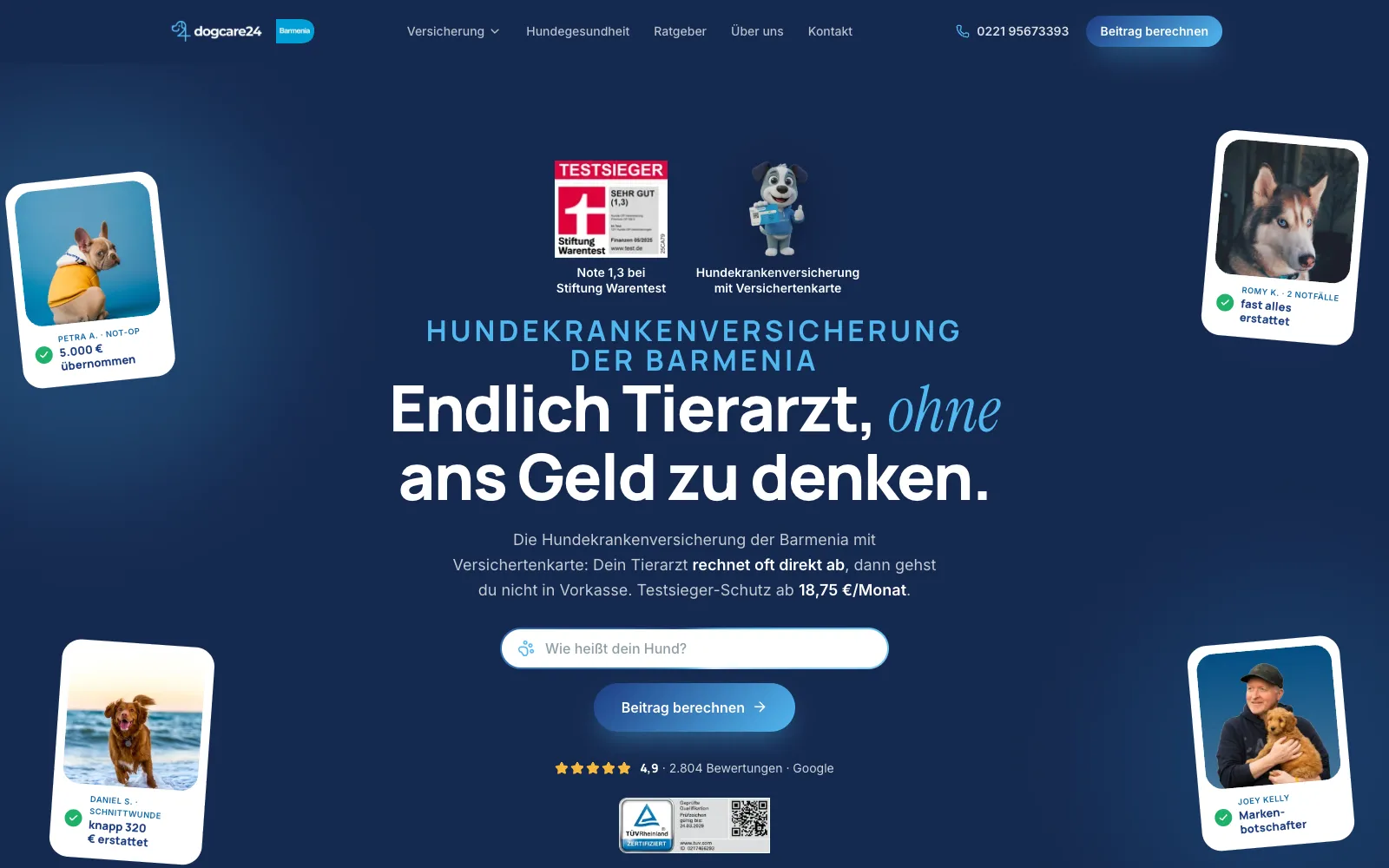
Dogcare24 brokers Barmenia’s dog health insurance. The funnel consists of a plan selection that shows dog owners the right plans, and an online sign-up. The site is built with Next.js and runs on Vercel.
The funnel does not stand alone. Many guide pages on breeds, costs, waiting periods and cover bring dog owners in from Google search and lead them into the plan selection. According to Search Console, clicks from Google rose from 8,627 in April 2025 to 29,528 in March 2026. Almost 50 leads per day now come from organic search (as of October 2026), more than twice as many as in December 2025. The lever was the combination: content that gets found and a flow that closes the sale. More projects from the industry are listed under Websites for insurers.
More examples
- Unfallpro24: a portal for accident victims looking for a vehicle damage assessor. The damage report first asks who caused the accident, then takes contact details and photos of the damage.
- Accron: a website focused on enquiries. Since launch, over 100 leads have come in, according to Kai Petry, Head of Sales.
Building blocks we use in funnels
Which building blocks make sense depends on your offer. We often use:
- Question flow: a few questions that clarify needs and budget before the form appears.
- Calculator: price, quote or savings calculators with your real rules.
- Plan selection and comparison: suitable options based on the visitor’s details.
- Product configurator: put together variants, see the price, send an enquiry.
- Appointment booking: straight into your calendar, with confirmation and reminder.
- Online sign-up and payment: contract or purchase without switching channels.
Each building block gets a landing page that explains who it is for. If you only need a simple landing page without a backend, our Web design is the right fit.
Why funnels fail
Funnels rarely fail because of technology, but because of the order of the questions. The most common mistakes:
- Asking for contact details too early: if you ask for a name and phone number in the first step, you lose many prospects. Show the value first, then ask.
- Too many steps without a result: every step needs a reason. If a calculator still shows nothing after eight questions, visitors drop out.
- Unclear next step: after submitting, it must be clear what happens and when someone will get in touch.
- Data ends up in an inbox: if enquiries are only handled days later, the prospect has often already gone to a competitor. A direct handover to the CRM and an automatic confirmation help.
- No tracking per step: without figures for each step, nobody knows where things get stuck.
We plan these points before the build, not once the numbers disappoint. After launch we look at the steps with the most drop-offs and test targeted changes to the question, the copy or the order there.
Where the visitors come from
A funnel is only as good as the visitors who enter it. For paid ads we build dedicated entry pages and measure which ad leads to sales. For a lasting, unpaid flow of visitors, we connect the funnel with content that ranks on Google. How that works is explained under SEO.
What a funnel costs
Funnel projects start at €4,500. The price depends on the number and type of steps, on calculation rules and integrations, and on whether the end result is an enquiry or a sale with payment. After the intro call you get a quote with a clear scope. If you want to know which flow suits your offer: Book an intro call.

 View